A redesign of Caloer, a calorie and nutrition-tracking app, focused on helping users build lasting healthy habits through behavioral design.
UX Research
UI/UX Design
Behavioral Design

Project Info
Team Project
Project Duration
Jul 2025 - Oct 2025
My Role
UX Researcher, UI/UX Designer
Problem Statement
Through user research and a heuristic evaluation of the existing Caloer app, we found three core issues that made people give up on habit-tracking:
Time & effort — Logging meals took too many steps and felt tedious.
Difficult food search — Finding a meal a user had already eaten was slow and frustrating.
Weak motivation & unclear rewards — There was little to keep users coming back, and progress dashboards felt complex and hard to read.
Solution
Key design solutions delivered across the journey:
Personalized onboarding that asks about the user's goals and makes them feel heard from the first screen.
Effortless meal logging, including a voice-note flow that makes journaling faster and more natural.
A smart menu feature with an "Eat Clean" meal-plan suggestion and full customization.
A natural Premium upsell surfaced at the right moment in the user's journey, rather than forced upfront.
Key Features
Product: Make the tracking experience seamless and enjoyable, so users can build a lasting habit.
Business: Increase the 7-day retention rate and improve conversion to the Premium plan.



Result
We validated the redesign through a final round of moderated usability testing (5 participants). Against our target tasks:
Logging a meal ("Bún chả"): 100% completion.
Choosing a free meal plan: 100% completion.
Upgrading to a Premium plan: 80% completion.
Creating a meal with AI: 100% completion.
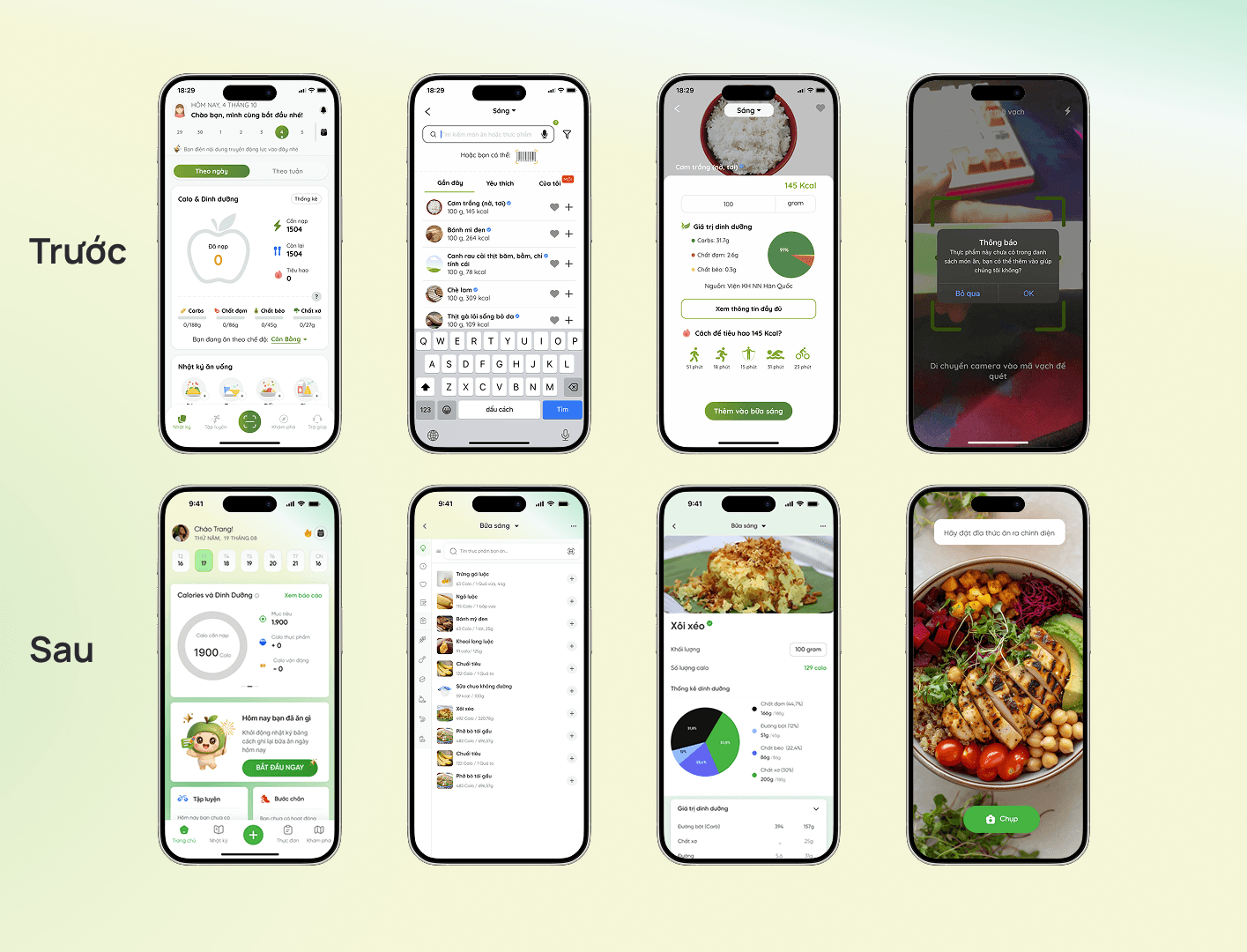
Before/after comparisons of the onboarding, logging, dashboard, and meal-plan screens showed a noticeably clearer, more motivating experience.
Takeaway
Learned to apply psychology and the Hooked Model to design for behavior change, not just screens.
Saw firsthand how heuristic evaluation and usability testing turn assumptions into evidence-based design decisions.
Practiced balancing user needs with business goals — designing a Premium path that feels helpful rather than pushy.